Newsletters

GHS Connect #7 Monday 20th October
{item_alt_tag}
GHS Connect #7 Monday 20th October

Mia's notes

5 days until we get to half term! Inset day when we return with the following schedule (which has already been put in an announcement).

Monday 3rd November INSET day. - plan for the day:

10:15am - arrival

10:30am - Staff meeting in hall. Ofsted preparation. All staff

11:15am - Teachers go to departments to undertake department activities as directed by Headteacher

12:30-1:15pm - Lunch

1:15pm - Teaching staff in the hall.  L&T INSET and lockdown procedure.

3pm - end of the day

Please also note that we have swapped the Whole School Staff Meeting on Tuesday 11th November with the Year Teams meeting on Tuesday 25th November due to a clash with Subject Network meetings.

- Year team meetings will take place on 11/11/25

- Staff meeting will take place on 25/11/25.

The meeting calendar has already been updated.

As I said in briefing last week, it’s been a successful first half term and I want to thank everyone for pulling together and working as such a great team.

When we all get there, I hope everyone has a fantastic half term break - everybody really deserves it!

Have a lovely week,

Mia


{item_alt_tag}

The week ahead

Monday
Normal Day

Tuesday
No meeting due to subject evening

Wednesday
Briefing in the library – 8.15am

Thursday
Year 13 Subject Evening. Check your appointments on the school cloud here

Friday
Normal Day

Notes
Year 10 Interim 1  (A2L; EMS: full)
Year 11 Interim 1


Learning and Teaching Tips and Strategies

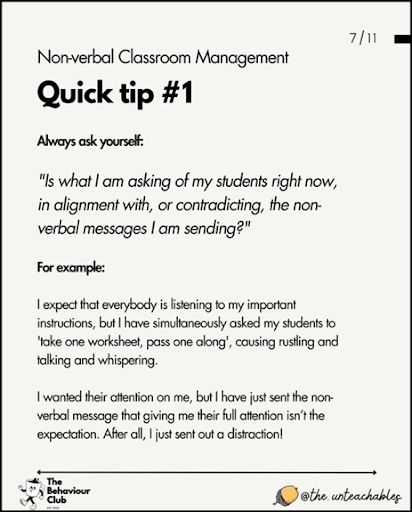
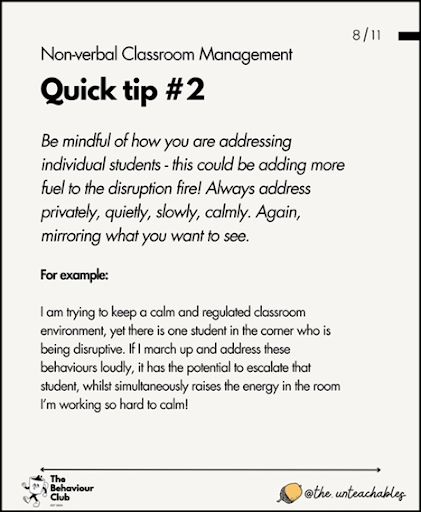
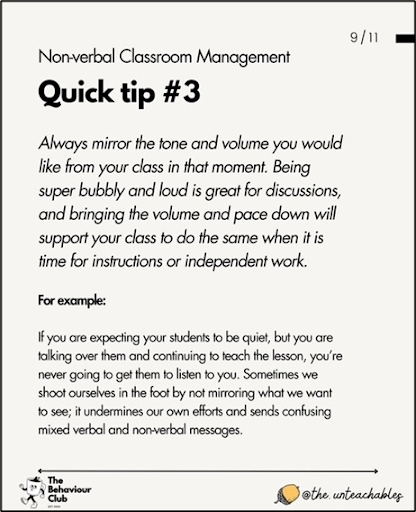
This week, we share 3 quick tips on non-verbal classroom management:

{item_alt_tag}
{item_alt_tag}

Want to explore further? Mark Roberts and Craig Barton share their thoughts on non-verbal gestures for classroom management here.


Behaviour - Managing Variables

A huge thank you to everyone. It’s been a brilliant half-term. As we reach the end, let’s remain in control over behaviour variables. 

These quick behaviour reminders are just to help us end this final week calmly and consistently— because tired teachers still make the biggest difference.

  1. Focus on the primary behaviour, not the secondary one.
    If they followed your main instruction, ignore the eye roll or sigh.
    Why? It keeps you in control and avoids unnecessary escalation when everyone’s patience is running low.
  1. Keep instructions short, clear, and calm.
    Save your energy — one calm, clear direction works better than three frustrated ones.
    Why? Clarity cuts through fatigue and helps students focus on what matters.
  1. Use non-verbal cues whenever possible.
    A look, a gesture, or proximity can often do more than words right now.
    Why? Reduces talking, lowers noise levels, and helps preserve your voice and energy.
  1. Pick your battles wisely.
    Ask yourself: “Will this matter in a week?” If not, let it go.
    Why? Protects your sanity and keeps relationships intact through the final stretch.
  1. Keep routines steady and predictable.
    Even when tired, consistency gives students a sense of calm and safety.
    Why? Predictability reduces anxiety and prevents end-of-term chaos.
  1. +1 Bonus: Be present around the school — even just visibly.
    A friendly face on the corridor or at the door quietly sets the tone.
    Why? Your presence reminds students that expectations still matter, without needing a word said.

Thank you – once again. Have a lovely break when we get there. It is much deserved.

Rav


Pastoral Reminders

Wellbeing

It is important for us to consider and understand our students' emotional and mental wellbeing. Please see below information around signs and support mechanisms to help you support our young people

Understanding Emotional and Mental Distress

Emotional or mental distress can affect any pupil, regardless of background or ability. It may be short-term, linked to a specific event, or part of a longer-term mental health condition such as anxiety, depression, or trauma.

Recognising the Signs of Distress

Behavioural Signs

  • Sudden changes in behaviour or personality
  • Withdrawal from friends, activities, or lessons
  • Increased irritability, aggression, or outbursts
  • Risk-taking behaviour or rule-breaking
  • Decline in academic performance

Emotional Indicators

  • Expressing feelings of worthlessness, hopelessness, or guilt
  • Talking about being overwhelmed or anxious
  • Difficulty concentrating or making decisions
  • Crying spells or emotional numbness

Physical Signs

  • Frequent unexplained physical complaints (headaches, stomach aches)
  • Fatigue or low energy
  • Self-harm marks (e.g. cuts, burns)
  • Neglected appearance or hygiene

Responding Appropriately

  • Immediate Actions for Staff
  • Stay calm and present.
  • Listen actively and non-judgmentally.
  • Reassure them.
  •  Follow Your School’s Safeguarding Protocols
  • Record concerns factually and sensitively (date, behaviour observed, what was said) on CPOMS.
  • Report to the Designated Safeguarding Lead (DSL) or appropriate pastoral staff immediately.
  • In urgent or high-risk cases (e.g. suicidal ideation, harm to others), seek immediate help via the school’s safeguarding lead or emergency services if needed.

Ongoing Support and Monitoring

  • Maintain regular, low-key check-ins with the pupil.
  • Collaborate with pastoral, SEN, and safeguarding teams.
  • Be consistent, approachable, and predictable in your interactions.
  • Support academic flexibility where needed (e.g. extensions, quiet spaces).

When to Seek Additional Help

  • Refer to internal or external mental health professionals if:
  • The pupil is showing persistent or worsening symptoms.
  • There is a known history of mental health issues.
  • You are unsure how to proceed or feel out of your depth.

 Useful Resources

  • YoungMinds – https://www.youngminds.org.uk
  • MindEd for Teachers – https://www.minded.org.uk
  • Anna Freud Centre – https://www.annafreud.org
  • NSPCC Learning – https://learning.nspcc.org.uk

Inclusion Heroes

This week I would like to thank the Parental Ambassadors: Silva Hilburn, Monika Sierkowska and Fuad Mohamed for organising the Year 7 Parent Workshop.  Can I also thank the Post 16 team for organising the lovely students registering parents and guardians and Ben Dyason for welcoming and facilitating throughout.   The event was informative for those that attended.

Hope you all had a lovely weekend.

Gurvinder Nayyar


Bright Spots

The first of this week's Bright Spots comes from Scott, who says:

I would like to nominate Adil Salamat for his amazing contributions in cover lessons while department colleagues were off school. He went into lessons, challenged behaviour, changed lessons to suit classes and stayed in class if needed. A super effort for which we are incredibly thankful for his support in this, true leadership skills shown!

The next Bright Spots nomination comes from Phoebe:

A massive thank you to Joseph, Haydar, Jen, Sabrina, Claire, Christabel, Ben, Justine, Buchi, Harj and Steve for supporting Studio 11 or Year 11 BG22 Study clubs, after school this year. The Studio 11 intervention has started well, and students are incredibly focused. The BG22 provision has also supported students to have a studious environment for revision and homework.


If there are any concerns about Equality and Diversity (staff)  at GHS please contact A Johal (DHT)


For the latest X feed from @ghsofficial, click here. For Threads, click here.

For the latest Instagram feed from @greenford_high_official, click here


17 Oct 2025
FELIX Food items - Staff
Please click here for further information. 
Read more